Tuesday, 18 September 2012

Research into Saul Bass

Saul Bass was a graphic designer and filmmaker, he designs film posters and motion picture title sequences.  Born on May 8th, 1920, in New York City. He has produced artwork for the following films; In Harm's Way, Advise and Consent, The Man With the Golden Arm, Exodus, Anatomy of a Murder. During his 40-year career Bass worked for some of Hollywood's greatest filmmakers, including Alfred Hitchcock, Otto Preminger, Billy Wilder, Stanley Kubrick and Martin Scorsese.

Saul BassPoster for Vertigo, 1958
Directed by Alfred Hitchcock
Saul BassPoster for The Two of Us
Saul BassSaul Bass on the set of Psycho with Alfred Hitchcock and Janet Leigh, 1960
© AMPAS


This is the opening sequence to the film 'Psycho'; 
The opening credits come onto the screen and the test is random being split into bars, which are constantly moving around. Not only is the text unstable and random but the bars are to, sometimes they will split or they will change the direction they come from, this to is changing all the time through out the sequence. This could then reflect on the split personality that the main character has. The music is very dramatic, it seems as if its trying to keep up with the patterns with the high pitched pluck of a string instrument one moment then a very low pitch pluck the next. It gives the feeling of suspense as the music is very unpredictable on what it will play like next. 


Friday, 14 September 2012

Using The Camera


Camera Work
Establishing shot
This shows the whole scene, all subjects/elements are in the shot, which then establishes a setting. Most likely to be a long shot.
Medium shot
Action shot, generally from the waist up, a shot where you are able to identify with a subject or character.
Close up
Head and shoulders shot; the emotion shot; an expression shot; the detail shot, the reaction shot. Used to signify importance or emotion.

Extreme close up
Only a part of the face or body or element fills the whole shot. Usually dominates the screen.


Aerial shot
Very high camera angle shot downwards towards the subject from a building, ladder or balcony. 


Two shot
Generally a profile shot of 2 people facing, normally engaging in conversation, Used to establish the relationship between them.


The 180-degree rule
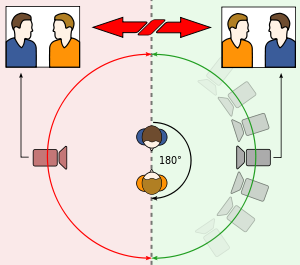
An invisible line in filming, which the camera does not cross. Establishing such a line prevents audiences from becoming disorientated, as they always see action and setting from a particular perspective.


Editing Work

Cut
The common transition used to create a sense of continuity and realism.
Cross Cutting
The editing technique of alternating or interweaving one narrative to another. 
Cutaway
A brief shot that momentarily interrupts a continuously-filmed action, by briefly inserting another related action, which is then followed by a cut back to the original shot.


We will be using the Imovie software to do the editing for our film.


Wednesday, 12 September 2012

Timeplan


Completion Date
Date Achieved
RESEARCH & ANALYSIS


Continuity exercise
26th October 2012
26th October 2012
Thriller title sequence
26th October 2012
26th October 2012

PLANNING


Continuity exercise
28th October 2012
One week after due date
Thriller title sequence
26th October 2012
One week after due date

CONSTRUCTION


Thriller opening


Filming
end of November 2012
19th December 2012
Editing
end of December 2012
January 2013

EVALUATION


Thriller opening


Assingment Brief

Video Brief


For our AS media studies coursework we were given the brief of completing a preliminary task and a main task.

For the preliminary task I have to film and edit a character opening a door, crossing a room and sitting down in a chair opposite another character, with who she/he then exchanges a couple of lines of dialouge. In this task i have to demonstrate match on action shot, reverse shot and the 180 degree rule.

We are also given a brief concerning our main task which is to create the titles and opening of a new fiction film, to a maximum of three minutes. Our main task has to include;

  • Pre-production: research, planning, development of ideas, scripting, storyboarding
  • Production: shooting, lighting, working with sets, actors and scripts
  • Post-production: editing, special and sound effects, music.


Camera Work

Camera Work
In my first media lesson we had a tutorial of how to set-up the tripod and dismantle it successfully. In our groups we  took it in turns to get to know the tripod. I thought it was quite simple to set-up  i now know how to use the tripod. We were also shown how to use the tripod for low angle shots, panning shots and high angle shots. We were also told about when carrying the tripod to make sure its folded in, in case of it catching on the wall and breaking for example. Ms Slater told us that once the camera is in the right position you do not touch it because you will get camera shake, that's why you have to be confident with the positioning before you start shooting. When we had finished with the tripods, we then got to know our cameras,where the battery's go,the buttons on the camera and where the charger will plug in. Then we placed them on charge ready for use in the upcoming lessons.